SCIGNALS · EEG / ExG
Signalino S3
An 8-channel amplifier for EEG, EMG and ECG.
24-bit acquisition, open formats and connections to your software through Signalino Suite, Python and LSL.
A project in development
Software for your signals
- Signalino Suite
- Visualization, impedance checks and recording. Preview releases for macOS, Windows and Linux.
- Python API
- Device access from your programs, with optional LSL and MNE support.
- Android
- Connect from your phone. Development applications distributed separately.
MORE TIME FOR RESEARCH
Your questions. Your tools. Your data.
Designed to work together
Electronics, enclosure, firmware and software, with the aim of reducing the time you spend on assembly.
Your analysis tools
Open formats and integration with your software. LSL through Signalino Suite to share recordings.
More possibilities within your budget
A compact format and an affordable cost are design goals, including when you need several acquisition points.
TWO STORIES, ONE IDEA
Does either of these stories sound familiar?
Two stories showing what we want to make possible with Signalino. Animated illustrations of the intended use cases.
Spanish audio with English subtitles.
EEG AND BIOSIGNALS · 2:24
Ana wants to do research.
More analyses, different measurements and multiple participants, without spending all your budget and time setting up equipment.
Read the transcript
CHRONIC RECORDINGS · 2:57
Marcos wants to expand his experiment.
More recording stations and the freedom to analyse his signals, while following the experiment from his office.
Read the transcript
FROM RECORDING TO ANALYSIS
Your software. Your way.
Signalino Suite and the Python API are part of the Signalino platform, including the new S3. View your signals, save your sessions or bring acquisition into your own tools.
Signalino Suite
The desktop application lets you connect the device, check impedances, view EEG and record sessions.
Installers are available in Preview for macOS Apple Silicon, Windows x64 and Linux Ubuntu/Debian amd64. Available features depend on the model, firmware and operating system; integration with S3 hardware will be evaluated with the first prototypes.
Installation notes and limitationsPython and your analysis tools
The Python API lets you bring acquisition into your software. It supports USB, Bluetooth Classic or Bluetooth Low Energy depending on the device; S3 is designed for USB and BLE.
python -m pip install signalinoOptional add-ons for LSL, MNE and the viewer can be installed with:
python -m pip install "signalino[all]"Share signals. Connect your experiment.
Lab Streaming Layer (LSL) lets applications share data and place their recordings on a common time reference. Signalino Suite can send EEG to compatible applications on the same computer or local network.
For example, you can record EEG and use another application to mark when an image appears or a sound plays. LSL helps relate both recordings so you can analyse the signal around each event.
You do not need LSL to view and save sessions in the Suite. It is there when you want to combine Signalino with other tools.
Learn more about LSL →An open ecosystem
The platform uses 33-byte binary frames compatible with the OpenBCI format. The integration with BrainFlow is a release candidate, while the integration with BCI2000 is still undergoing validation.
The repository brings together downloads, documentation and release notes. Scignals programs and supports devices directly during this phase; public firmware packages have not yet been released. Installing the Suite does not update the firmware.
Repository and documentation →
Technical support →SIGNALINO TAKES SHAPE
Eight channels to explore your ideas.
At the heart of Signalino S3 are the ADS1299 and ESP32-S3: eight 24-bit channels in a compact device designed to work with your own tools.
EEG to study brain activity, EMG to record muscle activity and ECG to observe cardiac activity. Different bioelectric signals—ExG—on one platform.
Signalino brings together custom electronics, an enclosure, firmware and software developed as one platform. We are looking for partner laboratories to try Signalino in their experiments and explore its possibilities together.
Signalino Suite, Python and documentation →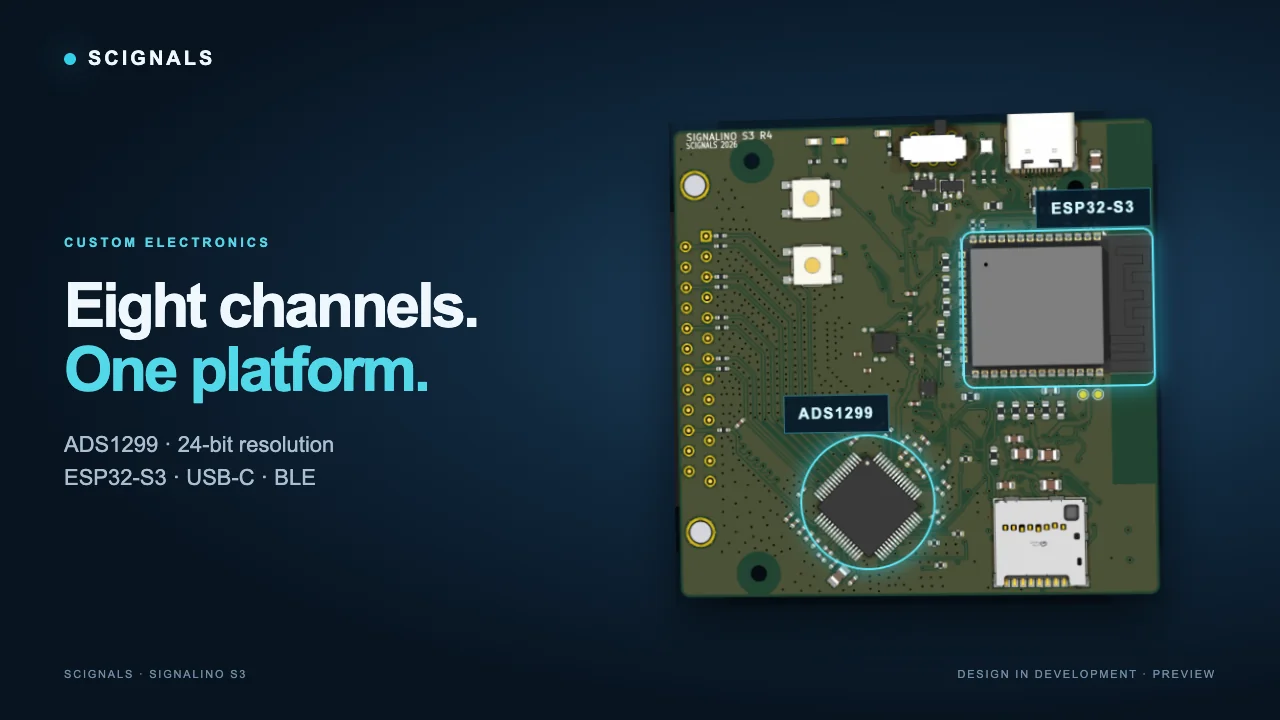
LET’S TALK ABOUT YOUR EXPERIMENT
Let’s take the next step together.
We are looking for laboratories willing to share their needs and explore evaluating the first prototypes. Tell us what you want to measure and what you would like to do differently.
I’d like to collaborate