SCIGNALS · SIGNALINO S3

A project in development

Your questions.
Your tools.
Your data.

We are creating a compact, affordable platform to record EEG and other bioelectric signals, and analyse them with your own software.

We are looking for partner laboratories to define their recording needs and evaluate the first prototypes.
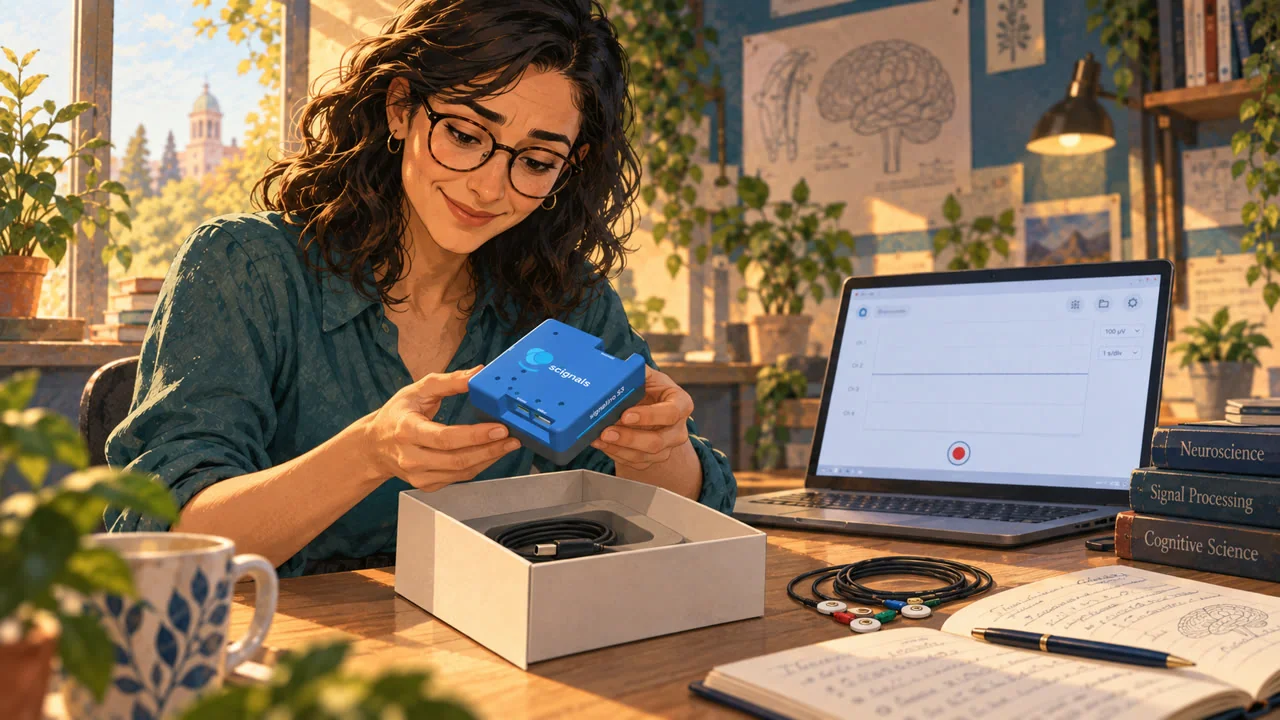
Illustration of Ana holding the Signalino S3 design
The experience we want to create. A concept illustration of the device.

MORE TIME FOR RESEARCH

Make it easier to expand your experiment.

Designed to work together

Electronics, enclosure, firmware and software, with the aim of reducing the time you spend on assembly.

Your analysis tools

Open formats and integration with your software. LSL through Signalino Suite to share recordings.

More possibilities within your budget

A compact format and an affordable cost are design goals, including when you need several acquisition points.

TWO STORIES, ONE IDEA

Does either of these stories sound familiar?

Two stories showing what we want to make possible with Signalino. Animated illustrations of the intended use cases.

Spanish audio with English subtitles.

EEG AND BIOSIGNALS · 2:24

Ana wants to do research.

More analyses, different measurements and multiple participants, without spending all your budget and time setting up equipment.

Read the transcript
This is Ana. She wants to study the brain. She gets an EEG system, buys the software and starts recording. Now she has signals. But no budget left. The data raises new questions. But her software cannot run the analyses she needs. She wants to use her usual tools. Proprietary formats and export restrictions get in the way. She also wants to record gaze and responses, and relate them to brain activity. But the programs work separately, and outdated connections make synchronisation difficult. Recording several people at once would save time. But more equipment means more cost. She looks for cheap boards. Now the numbers seem to add up. Until she has to sort out the cables, firmware, battery, enclosure and software. Then repeat the assembly. And synchronise everything. The days go by. Ana wanted to do research. Now she is building the equipment. That is why we are creating Signalino S3. A compact, affordable platform, with a device, enclosure, firmware and software designed to work together. We are designing it to make recording setup simple: connect the electrodes, configure the session and start. Without weeks of assembly. With open formats and access to your data. Eight channels and twenty-four bits to acquire biosignals, view them and record them. And analyse them with your own software. With LSL through Signalino Suite to combine measurements and coordinate recordings from several people. More analyses. New measurements. More participants. And your time, spent on research. Signalino S3. Your questions. Your tools. Your data. We are looking for partner laboratories to try the first prototypes. Tell us about your project.

CHRONIC RECORDINGS · 2:57

Marcos wants to expand his experiment.

More recording stations and the freedom to analyse his signals, while following the experiment from his office.

Read the transcript
Marcos studies how brain activity changes over days and weeks. To understand it, he makes chronic recordings in mice. He has a recording cage, a wall-mounted amplifier and a computer. The system works. But his questions keep growing. Now he wants to compare more animals. Try another condition. Record several at once. One more cage. Another amplifier. Another computer. And once again, the budget. When he adds up everything he needs, there is hardly any money left for the rest of the experiment. His ideas grow faster than his budget. Marcos also wants to analyse the signals with the software he already uses. But the equipment’s software has its limits. And getting the data out is not always easy. His questions change. The tools he bought do not. So he looks for a cheaper alternative. And finds boards that seem perfect. Small. Affordable. They just need assembling. Connect the cables. Set up the power supply. Program. Fix errors. Then do it again for each station, and get them all working together. Marcos wanted to study the brain. Now he is debugging connections. Expanding your experiment should not exhaust your budget. Or force you to become an engineer before you can do research. That is why we created Signalino S3. A compact, affordable platform, with hardware, enclosure, firmware and software designed to work together. A Signalino beside each cage, connected to the preparation’s electrodes. For these recordings, you power it with a phone charger. And the data reaches the computer wirelessly. Eight channels and twenty-four bits to acquire your biosignals. With LSL, open formats and your own software: Python, MNE, BCI2000, OpenViBE. To save your recordings and take them wherever you want. Now Marcos follows the experiment comfortably from his office. On screen: camera images and signals from each animal. More time to understand what is happening. Less time getting everything to work. Signalino S3. Your questions. Your tools. Your data. We are looking for partner laboratories to try the first prototypes. Tell us about your project.

SIGNALINO TAKES SHAPE

Eight channels to explore your ideas.

At the heart of Signalino S3 are the ADS1299 and ESP32-S3: eight 24-bit channels in a compact device designed to work with your own tools.

EEG to study brain activity, EMG to record muscle activity and ECG to observe cardiac activity. Different bioelectric signals—ExG—on one platform.

Signalino brings together custom electronics, an enclosure, firmware and software developed as one platform. We are looking for partner laboratories to try Signalino in their experiments and explore its possibilities together.

Explore the Signalino platform and its background →

What collaboration involves

  1. Tell us about your experiment. What you record, which tools you use and what holds you back.
  2. We assess the fit together. We define the requirements and what the prototype would need to demonstrate.
  3. We agree on a possible evaluation. When prototypes are available, we will define the scope, conditions and next steps.

This invitation is neither a reservation nor a purchase. No availability date has been announced yet.

LET’S TALK ABOUT YOUR EXPERIMENT

Help us build a tool that works for you.

We are looking for researchers and laboratories willing to share their needs and explore evaluating the first prototypes.

You do not need a list of specifications. Start by telling us what you want to measure.

You can also write to info@scignals.com.

Tell us which signals interest you, which tools you use and what you would like to improve.

Scignals will use these details to respond to your collaboration proposal. The form is processed through Un-static. Un-static privacy policy. This does not subscribe you to a mailing list.