
Memory and sleep
Complexity of modern societies requires us to lifelong learning, so that memory is a necessity that encompasses all life, until advanced ages. Unfortunately, a characteristic of human aging is the progressive decline in cognitive abilities, including impairment of long-term retention of episodic memories. These cognitive changes occur in parallel with prominent fea.tures of aging, as the structural frontal lobe atrophy and the difficulty in maintaining sleep, specially slow wave sleep (SWS). Recent evidences suggests that these traits of aging might be causally related to the cognitive decline associated with age. The advances in neuroscience research of sleep and memory have suggested that optimization of brain processes that occur during slow sleep, activated by different types of brain stimulation are able to improve memory, so that manipulation by physical, pharmacological or psychological means of SWS could be a therapeutic target to minimize the effects of memory impairment associated with age.
For background, read Perineuro on memory and sleep rhythms (in Spanish).
Closed-loop auditory stimulation (CLAS)
Can the brain’s electrical signals help us choose the right moment to deliver a stimulus during sleep? That is the idea behind closed-loop auditory stimulation, or CLAS.
This technology connects brain recordings with precisely timed sounds. It offers a way to explore interactions with sleep rhythms and better understand their relationship with memory.
What does «closed loop» mean?
In CLAS, EEG guides the delivery of brief sounds. The system records, analyses and stimulates, then keeps recording to decide when to act again.
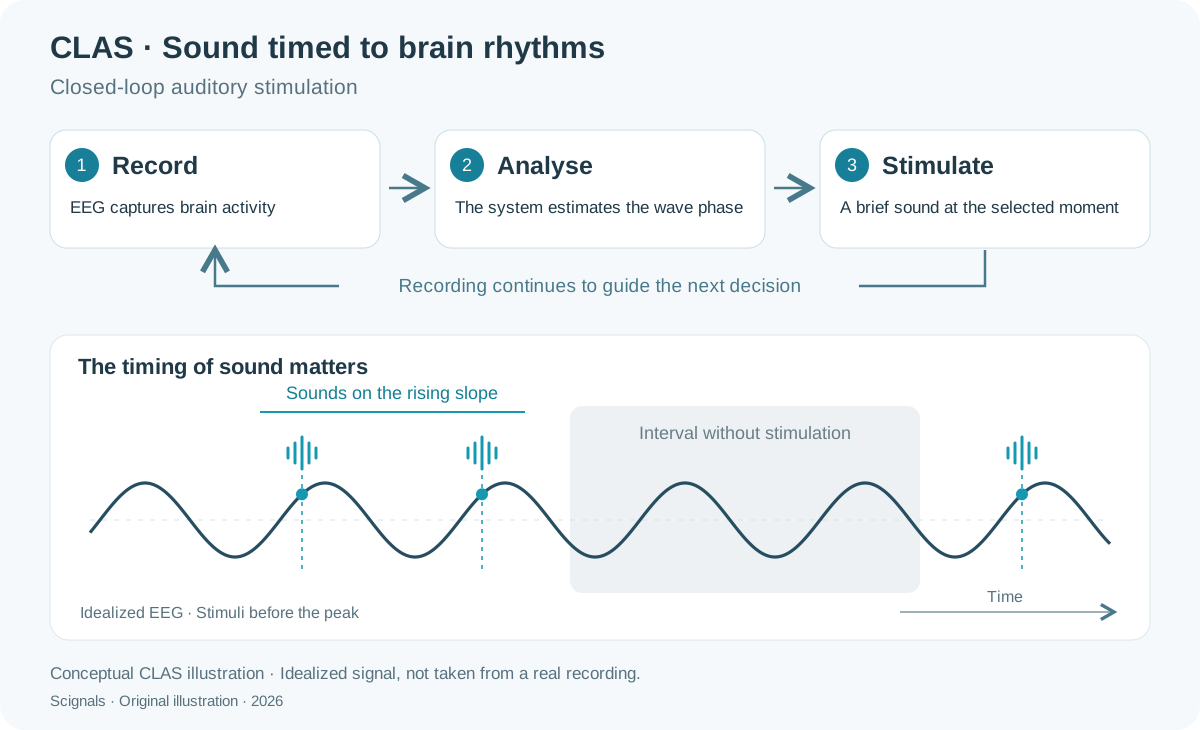
Timing is essential. Protocols targeting slow oscillations during non-REM sleep aim to deliver the stimulus at a particular phase of the oscillation. A 2013 study by Ngo and colleagues showed that this approach could strengthen slow oscillations and improve retention of word associations under the experimental conditions.
An active field of research
Subsequent studies have helped clarify the possibilities of CLAS. A home-based study, published online in 2025 and included in a 2026 issue, found increased slow-oscillation amplitude without detecting improvements in memory or vigilance in its sample of 34 participants. The authors identified sample size as a limitation.
These findings help sharpen the next questions: which physiological responses can be achieved, when they translate into performance changes, and how to evaluate systems outside the laboratory. These questions connect neuroscience research with the development of new engineering tools.
MemBoost
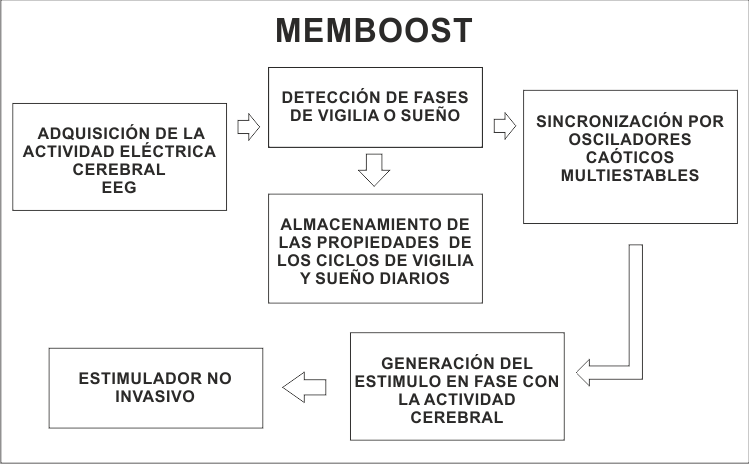
MemBoost is our project to apply closed-loop auditory stimulation to the study of sleep and memory. The proposal combines EEG recording, real-time analysis and sounds synchronized with brain activity in a portable, low-cost system.
The design encompasses four main functions:
- At-home recording of brain activity using EEG during sleep.
- Real-time EEG signal analysis.
- Cloud storage and access to data analysis tools.
- Non-invasive auditory stimulation synchronized with brain activity during sleep.
One research application is to study the relationship between stimulation during sleep and memory, including in the context of ageing. Evaluating these effects requires relating the brain’s response to stimuli to performance on memory tests.
Technology development
At Scignals, we envision MemBoost as our implementation of CLAS: a tool combining acquisition, processing and stimulation in a single system, allowing its operation to be studied outside the laboratory.
Our nighttime biomedical signal acquisition and processing project provides the technical foundation for this proposal. That work addressed wireless recording with Signalino, sleep-stage detection, synchronized stimulus generation and system miniaturization.
Integrating these elements supports the design of protocols in which EEG itself determines when sounds are delivered. Experimental evaluation of the implementation will need to assess both timing accuracy and the effects on brain activity and memory.
That is the goal of MemBoost: developing technology that can adapt to brain activity and contribute to the study of sleep and memory.
Recognition at actúaupm: third prize in 2015
The MemBoost proposal received third prize at actúaupm in 2015, the entrepreneurship competition run by the Technical University of Madrid. The award recognized the project’s concept and its potential as a technology venture.
Contribution to a UPM patent
Scignals contributed, through its team, to the invention described in the patent “Método y sistema electrónico para la asistencia cognitiva integral” (method and electronic system for comprehensive cognitive assistance), owned by the Technical University of Madrid. The invention combines augmented-reality assistance with a sleep-modulation system using stimuli synchronized with brain activity.
This contribution forms part of the team’s research experience in cognitive assistance, sleep and memory technologies, areas also addressed by MemBoost. The application was published in 2017 as ES2638280A1, followed by the granted patent in 2018 as ES2638280B2.
European support for the business plan
MemBoost received funding from Horizon 2020, the European Union’s research and innovation programme, to assess its feasibility and develop its business plan. The grant was awarded to Investigación y Lectura de Señales Biomédicas (ILSB) through phase 1 of the SME Instrument, alongside specialist advice.
The proposal combined a portable device for real-time EEG recording with software to identify wakefulness and sleep states and deliver auditory stimuli synchronized with brain activity. This approach connects directly with the CLAS technology described in this article.
This initial phase ran from March to August 2019, coordinated by ILSB, and received an EU contribution of €50,000, within a total budget of €71,429. The support enabled work on translating the technology proposal into a business venture.
The funding and objectives of this phase are documented in the MemBoost entry on CORDIS, project 854766.
IVACE support for technology development
Following the European grant for the business plan, technology development received support from the Valencian Institute of Business Competitiveness (IVACE) through the CREATEC-CV programme, with co-funding from the European Regional Development Fund (ERDF).
This support was provided through the nighttime biomedical signal acquisition and processing project, under reference IMCBTA/2019/30. The work covered wireless EEG recording with Signalino, sleep-stage detection, synchronized auditory stimulus generation and the miniaturization of a portable system.
The project’s technical objectives were achieved, providing a signal acquisition and processing foundation for the development of MemBoost.

MemBoost in the media
- https://computerhoy.com/noticias/hardware/memboost-dispositivo-estudiar-mientras-duermes-38119
- https://www.larazon.es/economia/emprendes-o-trabajas/8-startups-de-las-que-oiras-hablar-los-proximos-meses-BK13081527
- https://valenciaplaza.com/disenan-un-dispositivo-capaz-de-aumentar-un-40-la-retencion-de-lo-que-estudiamos